
Camping turns a road trip into an adventure and keeps lodging costs down.
In much of the West, it also means sharing the woods with black bears or grizzlies.
Bears are drawn to food and anything that smells like it.
A messy campsite can teach a bear to visit people, which ends badly for the bear and sometimes for the campers.
The good news is that most problems are easy to prevent.
This guide covers the basics, using guidance from the National Park Service in Yellowstone.
Rules differ between parks and forests, so always check the rules where you camp.
Choose your campsite carefully
Safe camping starts before you set up the tent.
The Yellowstone safety page gives a simple first rule.
Never camp where you see signs of bears, such as digging, tracks or scat.
If you notice those signs at an open site, choose another one.
In developed campgrounds, read the posted rules at the entrance.
They often explain local food storage requirements and recent bear activity.
What counts as a bear attractant
Many campers store their food well and forget everything else.
Bears follow smells, not labels.
The NPS lists common items that must be stored along with food.
- Beverage cans, full or empty.
- Coolers.
- Camp stoves.
- Cooking gear and clothes that have not been cleaned.
- Lip balm, sunscreen, bug spray and lotion.
- Toothpaste.
- Wash basins.
- Garbage.
- Pet food.
- Certain medications and menstrual products.
Make a habit of doing a final sweep of the site before bed.
Check picnic tables, tent pockets and car seats for wrappers and snacks.
How to store food and scented items
The safest choice depends on what your campsite offers.
The NPS describes several options in Yellowstone.
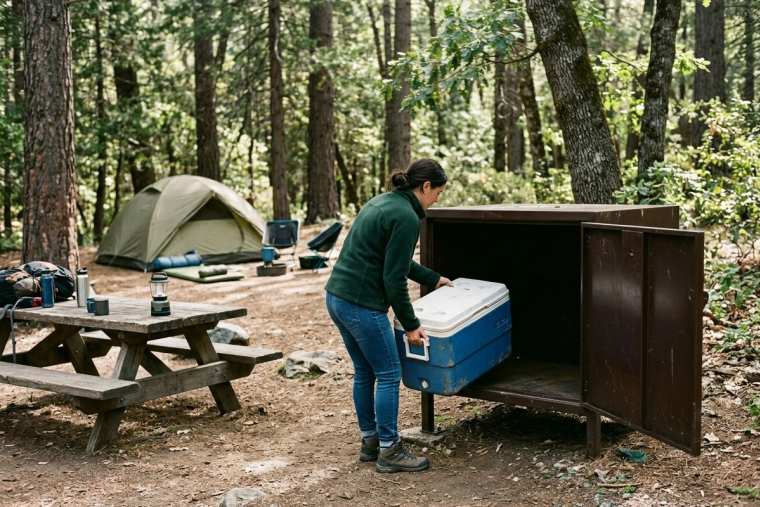
Use food lockers when they are provided
Many campsites have metal food lockers.
The park asks campers to use them for all food, garbage and smelly items.
Close and latch the locker every time, even if you will be back in a minute.
Hang food when there is no locker
If there is no locker, hang food and scented items from a provided food pole or a tree.
The NPS says you need at least 35 feet of rope.
Hang everything at least 10 feet above the ground and 4 feet away from the tree trunk.
Use an approved bear-resistant container
In Yellowstone, only hard-sided containers approved by the Interagency Grizzly Bear Committee may replace hanging.
Make sure all food and scented items fit inside before your trip starts.
Other parks may have their own approved lists, so check before you buy.
Keep your gear close during the day
The NPS warns not to leave packs, bags or coolers with food unattended, even for a few minutes.
When you are not using them, store them in your vehicle or a bear-proof locker if available.
Animals learn new food sources fast.
Where bears are known to break into vehicles, local rules may require lockers instead of cars.
Follow the rule posted where you are.
Cook and clean up the right way
Cooking smells travel far.
The NPS gives clear steps for cooking and cleaning in bear country.
- Strain food bits out of your dishwater.
- Store or pack out all garbage properly.
- Scatter wash water at least 100 yards from your tent site.
- Remove food scraps and garbage from fire pits.
Clean up right after each meal instead of leaving it for the morning.
Never burn leftovers and walk away from the fire pit.
Keep your sleeping area separate
Where you sleep matters as much as where you cook.
The NPS advises sleeping at least 100 yards from the area where you cook, eat and store food.
Choose a spot upwind of the cooking area if you can.
- Never cook in your tent.
- Do not sleep in the clothes you wore while cooking.
- Double-check that all scented items are stored with the food.
In a crowded developed campground, 100 yards may not be possible.
In that case, follow the campground rules and keep the tent completely free of food and smells.
Carry bear spray and know how to use it
Bear spray is a non-lethal tool designed to deter bears as a last line of defense.
The NPS says it is highly successful at stopping aggressive behavior in bears.
It sprays a cloud instead of a stream, so you do not need perfect aim.
- Each person in the group should carry one can.
- Keep it in a holster on your waist or chest, not inside a pack.
- In thick brush or poor visibility, carry it in your hand.
If a bear charges, the park describes the steps.
- Remove the safety clip.
- Point the nozzle slightly down and adjust for any crosswind.
- Spray when the bear is 30 to 60 feet away to create a wall between you.
- Keep spraying until the bear changes direction.
- Leave the area quickly, but do not run.
Bear spray is a deterrent, not a repellent.
Never spray it on your body, your tent or your gear.
Never leave bear spray in a hot car
This tip matters a lot on a road trip.
The NPS warns that bear spray can explode if it reaches 120°F.
A parked car in summer can get much hotter than that.
The park advises against storing bear spray in the passenger compartment of a vehicle or near heat sources.
Bear spray also cannot be taken on airplanes.
If you fly in and rent a car, plan to buy or rent it near the park.
Do not throw used cans in the trash, since they can injure people.
Use a recycling or drop-off site where one is available.
Our guide on road trips in hot weather covers how fast a parked car heats up.
On the trail near camp
Short walks from camp carry their own risks.
The NPS reports that since 1970, 91% of people injured by bears in Yellowstone were alone or with one partner.
It recommends hiking in groups of three or more.
- Make noise so you do not surprise a bear.
- Scan the area often.
- Hike in daylight and avoid dawn, dusk and night.
- Stay on maintained trails.
- Leave the area right away if you find an animal carcass.
If a bear comes into camp
Sometimes a bear wanders close despite your best efforts.
The NPS advises making sure your food is secure and making noise to discourage it.
If a bear enters camp, grab packs and any food that is not stored, then slowly back away.
Do not let the bear get your food.
Report every bear encounter to a ranger, no matter how minor.
A bear-country camping checklist
- Campsite free of tracks, digging and scat.
- Every food and scented item stored in a locker, hung or in an approved container.
- Wash water scattered 100 yards from the tent.
- Tent far from the cooking area and free of food smells.
- One can of bear spray per person, carried within reach.
- Bear spray kept out of the hot passenger compartment.
- Hikes taken in daylight and in groups.
For more trip planning, see our guide to planning a national park road trip.
The bottom line
Bears rarely cause trouble for campers who manage smells and food carefully.
Pick a clean site, store every scented item and cook far from where you sleep.
Carry bear spray on your body, and never leave it in a hot car.
A tidy camp keeps both you and the bears safe.
Sources and Further Reading
- National Park Service, Yellowstone National Park: Safety — supports campsite selection, the list of attractants, food lockers, hanging measurements and approved containers, cooking and cleanup steps, sleeping distance, bear spray use and storage, and the hiking group statistics.
- National Park Service: Trip Planning Guide — supports checking each park's rules and conditions before your trip.