
Driving after dark feels different, even on a road you know well.
Colors fade, distances are harder to judge, and the edges of the road blend into the shadows.
Your headlights only show a slice of what lies ahead.
Oncoming lights can leave you squinting for several seconds at the worst possible moment.
This guide covers how to use your headlights well, how to deal with glare from other drivers, and how to handle the low sun at dawn and dusk.
Why night driving is harder
Most of the information you use to drive comes through your eyes.
At night, there is simply less of it.
Your headlights light up the road in front of you, but not the sides, the shoulder or the far distance.
Some road users are especially hard to spot in the dark.
The California Driver Handbook warns that motorcycles, pedestrians and bicyclists are much harder to see at night.
A person in dark clothes on an unlit road may appear in your headlights only a moment before you reach them.
Your eyes also need time to adjust when the light changes.
The handbook advises driving slowly after you leave a brightly lit place, until your eyes adjust to the darkness.
A gas station, a store parking lot or a tunnel exit can all leave you briefly half-blind.
Never outdrive your headlights
One simple rule sits at the heart of safe night driving.
The California handbook says to make sure you can stop in the distance lit by your headlights.
If something appears at the edge of your beams, you need room to stop before you reach it.
When your speed is too high for your lights, you are driving into a space you cannot see.
Low beams reach a shorter distance than high beams, so they call for a lower speed.
On a dark, winding road, that may mean driving well below the posted limit.
The speed limit is a maximum for good conditions, not a target for every night.
When to use high beams and when to dim them
High beams are a useful tool when the road is empty.
The handbook says to use them on open country roads or dark city streets.
It also says not to use high beams in areas where they are illegal.
Dim them as soon as they could blind someone else.
The handbook tells drivers to dim high beams to avoid blinding the driver of an oncoming vehicle.
A good habit is to switch to low beams as soon as you see the lights of an approaching car.
Do the same when you come up behind another vehicle, since your high beams flood their mirrors.
Many states set exact distances for dimming your lights. Check your own state driver handbook for the local rule.
Rain, fog and smoke call for low beams
The handbook says to use low-beam headlights when it is raining.
In heavy fog or smoke, it warns that high beams reflect back and cause glare.
Never drive with only your parking lights on, in any weather.
How to handle glare from oncoming headlights
Sooner or later, a driver will come toward you with lights that are far too bright.
Maybe their high beams are on, or their headlights are aimed too high.
The California handbook gives clear steps for this moment:
- Do not look directly into the oncoming headlights.
- Look toward the right edge of your lane.
- Watch the oncoming vehicle out of the corner of your eye.
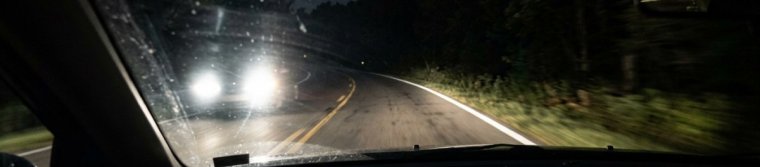
Using the right edge of your lane as a guide keeps your car on track while your eyes stay protected.
Easing off the speed a little also helps, because it gives you more time if you briefly lose sight of the road.
Do not fight glare with glare
It is tempting to flash your high beams back at a driver who blinds you.
The handbook says not to react by keeping your own high beams on.
It explains that this only makes it harder for both drivers to see.
Two blinded drivers on a narrow road is the last thing anyone needs.
A single light coming toward you
Sometimes you see only one headlight approaching.
The handbook says to drive as far to the right as possible in that case.
It could be a bicyclist, a motorcyclist or a car with a missing headlight.
Give it extra room until you know what it is.
Keep your glass and lights clean
Dirt and film on your windshield scatter light and make glare much worse.
Clean the inside and outside of the glass regularly, not only when it looks dirty in daylight.
Replace wiper blades that leave streaks, since streaks catch every passing light.
Walk around the car now and then to check that both headlights and all taillights work.
Wipe road grime off the headlight lenses, especially in winter.
If your headlights seem dim or aimed oddly, ask a repair shop to check their aim.
Keep the inside of the car dark too. Turn the dashboard and screens down to a comfortable level.
Watch for construction and wildlife after dark
Road work often happens at night, when traffic is lighter.
The California handbook reminds drivers that highway construction can take place at night.
It advises reducing your speed in highway construction zones.
Lanes may shift, workers may be close to traffic and equipment may move without warning.
In rural areas, animals often cross roads around dusk and during the night.
Scan the shoulders as well as the lane, and look for eyes reflecting your headlights.
Managing sun glare at sunrise and sunset
Glare is not only a nighttime problem.
A low sun near the horizon can be just as blinding as an oncoming car with high beams on.
It often strikes during the morning and evening commute, when roads are busiest.
The California handbook lists several ways to manage sun glare:
- Keep the inside and outside of your windshield clean.
- Wear polarized sunglasses.
- Keep enough space between your vehicle and the vehicles around you.
- Make sure your visor works and nothing blocks it.
- Watch for pedestrians, who may be very hard to see.
- Try to avoid driving during sunrise and sunset when you can.
Extra following distance matters a lot here.
When you cannot see brake lights clearly, a bigger gap gives you time to react.
If the glare is so strong that you cannot see the road, slow down gradually and find a safe place to pause.
Take care of your eyes and your energy
Good vision makes every part of night driving easier.
If you notice more trouble seeing at night than you used to, have your eyes checked by an eye care professional.
Halos around lights, blurry signs or slow recovery from glare are all worth mentioning at your next exam.
Night driving also tends to fall at times when the body wants to sleep.
The National Heart, Lung, and Blood Institute explains that sleep deficiency affects how well you think and react.
If you feel your eyes getting heavy, stop somewhere safe and rest.
Our guide to drowsy driving warning signs explains what to watch for.
A quick night driving checklist
- Clean the windshield, mirrors and headlight lenses.
- Check that all lights work before a long night drive.
- Drive at a speed that lets you stop within your headlights.
- Use high beams on empty dark roads and dim them early for other drivers.
- Look to the right edge of your lane when oncoming lights are bright.
- Slow down after leaving bright places and in construction zones.
- Watch closely for pedestrians, bicyclists, motorcycles and animals.
- Stop and rest if you feel tired.
The bottom line
Night driving rewards patience.
Slow down enough to stop within your lights, and dim your high beams for everyone else.
When glare hits, look to the right edge of your lane instead of into the light.
With clean glass, working lights and a rested driver, the dark road becomes far less stressful.
Sources and Further Reading
- California DMV: California Driver Handbook, Section 8, Safe Driving — supports stopping within the distance lit by your headlights, when to use and dim high beams, the steps for handling oncoming glare, the single-headlight advice, low beams in rain and fog, night construction zones and the sun glare tips.
- National Heart, Lung, and Blood Institute: Sleep Deprivation and Deficiency — supports the point that lack of sleep affects how well you think and react.