
Seeing a bison, an elk or a bear from your car is one of the great moments of a western road trip.
It is also a moment when drivers make risky choices.
People stop in the middle of the road, jump out with a phone or drive too close for a better look.
In wildlife country, the road belongs to the animals as much as to the cars.
This guide explains how to drive, stop and watch wildlife safely, using guidance from the National Park Service.
Many examples come from Yellowstone, where large animals and heavy summer traffic meet every day.
The biggest danger is usually the road itself
Many visitors worry most about bears.
The numbers point somewhere else.
The Yellowstone safety page says traffic-related accidents are the most common cause of injury and death in the park.
The scenery is distracting, the roads wind and other drivers stop without warning.
The park asks drivers not to let the views pull their attention from the road.
Watch for animals at all times, not only when someone points one out.
Slow down and expect the drive to take longer
Park roads are not highways.
In Yellowstone, the speed limit is 45 mph unless a sign shows a different limit.
The park also warns that winding roads and traffic often make drive times much longer than expected.
Other hazards include soft shoulders, potholes and frost heaves.
Plan your day with that in mind.
- Add extra time to every leg that crosses a park.
- Do not schedule a tight dinner reservation after a long scenic drive.
- Fill the tank before you enter large parks with few services.
- Keep snacks and water in the car for slow stretches.
A relaxed schedule makes it easier to drive patiently when traffic stops for animals.
Use pullouts, never the travel lane
When you spot an animal, the temptation is to stop right where you are.
That blocks traffic and puts everyone at risk.
The NPS asks drivers not to block traffic to take pictures.
Instead, use the pullouts built along park roads.
- Signal early so drivers behind you know you are slowing.
- Pull into a marked pullout or a wide, safe spot.
- Make sure all four wheels are completely off the road.
- Stay with your vehicle and watch from there.
- Check mirrors and traffic carefully before pulling back out.
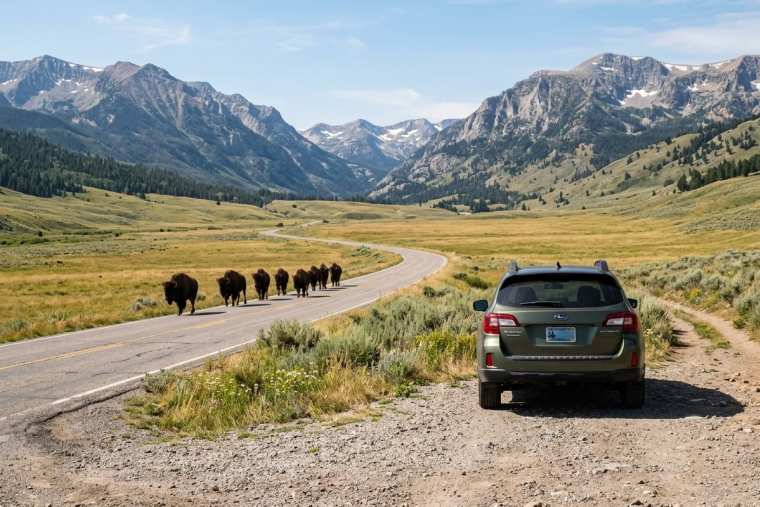
If there is no pullout, keep driving.
Another viewing spot usually appears down the road.
What to do in a wildlife jam
Sometimes animals walk right onto the road.
In Yellowstone, a herd of bison can stop traffic for many minutes.
Locals call it a bison jam.
The park gives clear guidance for these moments.
- Be patient and drive slowly.
- Stay in your vehicle.
- Wait for the animals to move along on their own.
- Do not honk your horn at them.
- Do not drive aggressively toward them to push them off the road.
The NPS also asks drivers to stay with their vehicles in any wildlife jam.
Getting out to walk closer is how many dangerous encounters begin.
Take extra care at night and in poor visibility
Bison are huge, and their dark coats are hard to see after dark.
The park warns drivers to be especially careful at night or anytime visibility is poor.
The same is true for elk, deer and moose on many western roads.
- Drive below the speed limit when you cannot see far ahead.
- Use high beams when no other car is coming.
- Scan the edges of the road, not just the center of your lane.
- Slow down where you see one animal, because others are often nearby.
Our guide on driving in fog covers more habits for low-visibility driving.
How close is too close?
Wild animals can look calm and slow.
They are not tame, and they can move very fast.
The Yellowstone guidance sets clear minimum distances.
- Bears, wolves and cougars: stay at least 100 yards away.
- All other animals, including bison and elk: stay at least 25 yards away.
If an animal moves closer to you, back away to keep that distance.
The park notes that bison have injured more people in Yellowstone than any other animal.
They can run three times faster than humans.
The NPS says the safest view of wildlife is often from inside a car.
For a closer look, use binoculars or a telephoto lens instead of your feet.
Know the seasons when animals are on edge
Animal behavior changes through the year.
The park highlights two periods for elk.
In spring, from May to early July, cow elk protect their calves fiercely.
They may charge or kick even at people more than 25 yards away.
Around Mammoth Hot Springs, they sometimes hide calves near cars or buildings.
Be careful when you walk back to your parked car.
In the fall, from September through October, bull elk are in their mating season.
The park warns they are stressed and unpredictable and may charge cars and people.
Give them extra space, even when you are inside the vehicle.
Never feed wildlife, even from the car window
Tossing a snack to a squirrel or a bird may seem harmless.
The NPS explains why it is not.
Animals that depend on human food may become aggressive toward people.
Some of them later have to be killed.
Wild animals also carry diseases that can spread to people.
Keep food inside the car with the windows up when animals are near.
Do not leave coolers, bags or packs unattended at a picnic spot, even for a few minutes.
The park notes that ravens have learned to open zippers and buckles to reach food.
If a bear approaches your car
Seeing a bear walk up to your vehicle can be startling.
The Yellowstone guidance is simple.
If a bear approaches or touches your car, honk your horn and drive away.
Report the behavior to a ranger as soon as you can.
This discourages the bear from treating cars as a source of food.
If you are ever involved in a conflict with any animal, report it to park staff.
If you have cell service, you can call 911.
Prepare before you reach the park
Good wildlife viewing starts with good planning.
The NPS trip planning guide encourages visitors to research a park before they go.
Check alerts and road conditions on the park website before you leave.
Rules can differ from park to park, so read the safety page for each one on your route.
Our guide to planning a national park road trip covers reservations and essentials.
A wildlife-country driving checklist
- Extra time added to every park leg.
- Speed kept at or below the posted limit.
- Pullouts used, with all four wheels off the road.
- Everyone stays in the car during wildlife jams.
- At least 100 yards from bears and wolves, 25 yards from other animals.
- Binoculars packed for a closer look.
- Food kept inside the car and never offered to animals.
- Extra caution after dark and in poor visibility.
The bottom line
Wildlife makes a park road trip unforgettable.
Drive slowly, use pullouts and stay in your car when animals are close.
Keep your distance, keep your food to yourself and stay patient in a wildlife jam.
That way, the only thing you take home from the encounter is a great memory.
Sources and Further Reading
- National Park Service, Yellowstone National Park: Safety — supports the traffic accident statistics, the 45 mph speed limit, pullout and wildlife jam guidance, the viewing distances, the bison and elk warnings, the rule against feeding wildlife and what to do if a bear approaches your car.
- National Park Service: Trip Planning Guide — supports the advice to research each park and check alerts and conditions before your visit.